Engineering implication
Enforce resource budgets around model and tool calls.
// engineering radar · AI Engineering
Cost optimization controls the resources needed to achieve a verified task outcome.
Cost optimization controls the resources needed to achieve a verified task outcome. Token usage, retries, retrieval and tool operations all contribute to total cost. Caching or cheaper routes should be assessed against freshness, privacy and task correctness, not only the price of a model call.

RouteLLM evaluates quality–cost trade-offs from routing requests between models; its results are benchmark-specific, not a saving promised here. [1]
RouteLLM: Learning to Route LLMs with Preference DataOng et al. · arXiv · Paper
PagedAttention addresses inefficient KV-cache management to improve LLM-serving throughput under evaluated workloads. [2]
Efficient Memory Management for Large Language Model Serving with PagedAttentionKwon et al. · SOSP / arXiv · Paper
References support the specific statements above. Definitions are paraphrased synthesis; scenarios, diagrams, implementation checks and portfolio connections are independent educational examples, not results reported by these sources.
Include failed attempts and retries in cost analysis.
A workflow uses a bounded context and scoped cache for repeatable read-only questions, while retaining full validation for consequential actions.
Budget exhaustion can cause incomplete verification, and an incorrectly scoped cache can return another user's data.
Connected engineering concerns
These technologies address adjacent design constraints. Connections express conceptual relationships, not citations or measured dependencies.
Independent implementation perspectives · illustrative, not findings reported by the cited sources.
Enforce resource budgets around model and tool calls.
Keep budget exhaustion from bypassing required validation.
Scenario-based testing, traceable evidence and failure recovery for AI systems beyond the demo.
A plausible response can conceal incorrect reasoning, unsafe tool use or brittle recovery. These personal technical perspectives examine how representative tests and operational evidence can support release decisions without claiming unmeasured results.
Portfolio work sharing this technology’s domains. Shared subjects indicate editorial relationships, not citations.

Published on RSA Conference official library: AI-driven threats move at machine speed, so security must shift from monitoring to autonomous response. Why self-healing systems that isolate, repair and recover on their own are now essential — and how intent, time and interaction put guardrails on defensive automation.
RSA Conference
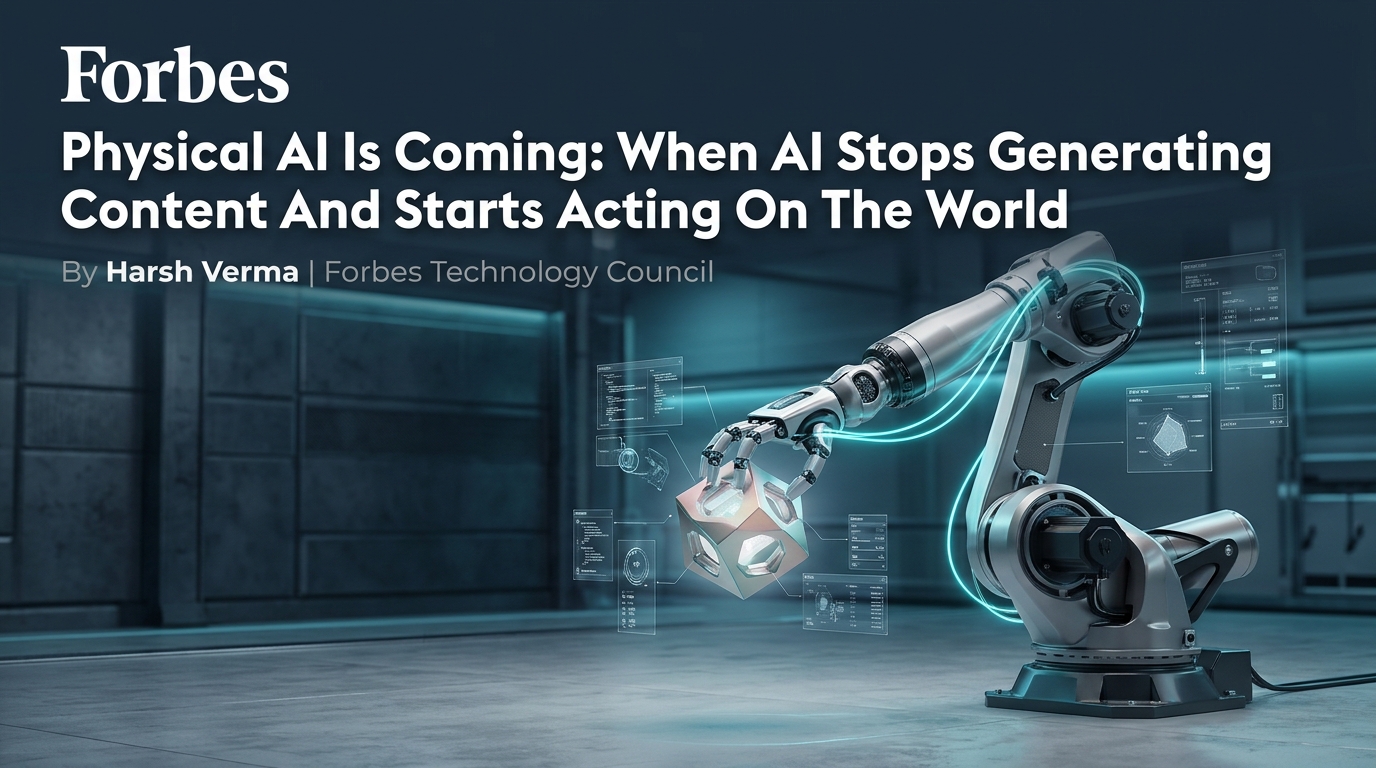
Generative AI was defined by digital creation—LLMs generating text, summarizing data, and generating code where errors can be edited. Physical AI brings artificial intelligence into the real world through sensors and robotic actuation, where actions have irreversible physical consequences and there is no 'undo' button.
Forbes Council

As code generation becomes commoditized, the next generation of engineers will differentiate through systems architecture, deterministic safety guardrails, prompt unit economics, and holistic cognitive system design.
Forbes Council

Moving past vanity parameter counts to evaluate enterprise AI investments through cost-performance efficiency, token ROI, deterministic output density, and measurable business throughput.
Forbes Council

An architectural examination of the fundamental tension between contextual user personalization and enterprise zero-trust data privacy in modern retrieval and agent ecosystems.
Forbes Council

In mission-critical enterprise environments, repeatability and mathematical predictability command a higher commercial premium than stochastic creativity. How to design deterministic control layers over generative models.
Forbes Council