Engineering implication
Keep evaluation evidence reproducible.
// engineering radar · AI Engineering
Reliability engineering anticipates failure across the full AI execution path.
Reliability engineering anticipates failure across the full AI execution path. Timeouts, retries, idempotency and recovery matter alongside answer quality. A reliable system reports incomplete work honestly and validates committed state rather than interpreting a successful model response as a successful workflow.
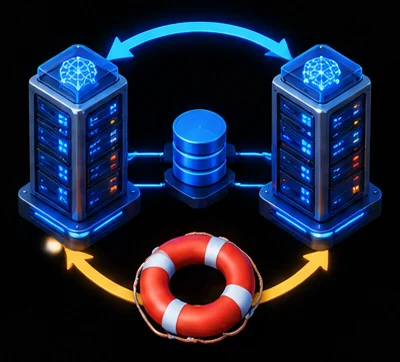
Google SRE explains how retries amplify failures and recommends bounded retry budgets and backoff. [1]
Addressing Cascading FailuresGoogle · Site Reliability Engineering · Engineering guidance
RFC 9110 defines idempotency by whether repeated identical requests have the same intended server effect as a single request. [2]
RFC 9110: HTTP Semantics · §9.2.2 Idempotent MethodsIETF · Standard
References support the specific statements above. Definitions are paraphrased synthesis; scenarios, diagrams, implementation checks and portfolio connections are independent educational examples, not results reported by these sources.
Use deadlines, bounded retries and idempotency keys.
After a tool times out, a workflow checks whether the write already completed before deciding whether a retry is safe.
A retry without state inspection can duplicate a write; a silent partial failure can leave users believing the task is complete.
Connected engineering concerns
These technologies address adjacent design constraints. Connections express conceptual relationships, not citations or measured dependencies.
Independent implementation perspectives · illustrative, not findings reported by the cited sources.
Keep evaluation evidence reproducible.
Check intermediate actions and final outcomes.
Scenario-based testing, traceable evidence and failure recovery for AI systems beyond the demo.
A plausible response can conceal incorrect reasoning, unsafe tool use or brittle recovery. These personal technical perspectives examine how representative tests and operational evidence can support release decisions without claiming unmeasured results.
Portfolio work sharing this technology’s domains. Shared subjects indicate editorial relationships, not citations.

Published on RSA Conference official library: AI-driven threats move at machine speed, so security must shift from monitoring to autonomous response. Why self-healing systems that isolate, repair and recover on their own are now essential — and how intent, time and interaction put guardrails on defensive automation.
RSA Conference

Generative AI was defined by digital creation—LLMs generating text, summarizing data, and generating code where errors can be edited. Physical AI brings artificial intelligence into the real world through sensors and robotic actuation, where actions have irreversible physical consequences and there is no 'undo' button.
Forbes Council

As code generation becomes commoditized, the next generation of engineers will differentiate through systems architecture, deterministic safety guardrails, prompt unit economics, and holistic cognitive system design.
Forbes Council

Moving past vanity parameter counts to evaluate enterprise AI investments through cost-performance efficiency, token ROI, deterministic output density, and measurable business throughput.
Forbes Council

An architectural examination of the fundamental tension between contextual user personalization and enterprise zero-trust data privacy in modern retrieval and agent ecosystems.
Forbes Council

In mission-critical enterprise environments, repeatability and mathematical predictability command a higher commercial premium than stochastic creativity. How to design deterministic control layers over generative models.
Forbes Council