False positive triggers service shutdown
A suspicious login causes an agent to disable a critical account. Require asset criticality checks and choose a narrower reversible action before escalating.
// research & expertise · personal technical perspective
Detection, response and recovery with bounded autonomy and accountable oversight.

Research thesis
Attackers can automate at a pace that exceeds manual response, but unconstrained defensive automation can interrupt legitimate services. An agentic SOC needs containment that is fast, proportionate and reversible where possible.
These are personal technical perspectives and proposed design patterns, not employer-endorsed architecture or claims of experimentally validated findings.
Join alerts with trustworthy telemetry and asset context. Preserve the difference between an anomaly, a suspicious sequence and a confirmed incident. Model confidence alone is not sufficient evidence for a disruptive action.
Start with observation, then reversible containment, then actions requiring human approval. Limit blast radius by resource, duration and action class; maintain a clear emergency stop.
Verify system state after a response and ensure restoration does not reintroduce the threat. Self-healing is a controlled recovery workflow, not a guarantee that systems repair themselves without supervision.
Exercise evasion, fabricated telemetry, poisoned context and tool outages. Test the impact of false positives as well as missed detections. Measure operational disruption and recovery alongside detection quality.
A suspicious login causes an agent to disable a critical account. Require asset criticality checks and choose a narrower reversible action before escalating.
Detection succeeds but containment fails. Record the failed action, avoid claiming resolution and escalate to an accountable responder.
Part of the Connected Knowledge Graph
85 related works · 8 content types
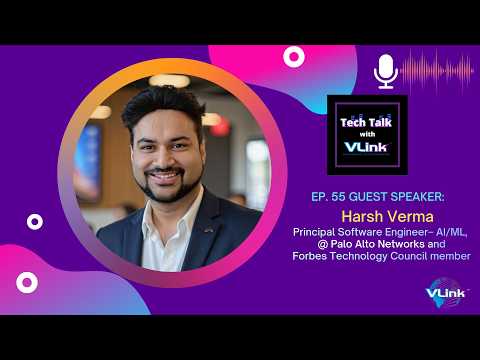
Deep-dive executive presentation covering enterprise AI architectures, scaling multi-agent workloads, identity boundaries, and real-time behavioral defense.
TechTalk with VLink Keynote (Ep. 55)
Published · This presentation introduces the emerging paradigm of multi-agentic AI in cybersecurity, where systems evolve from passive tools to autonomous decision-making entities. This explores the rise of agentic AI and its transformative impact on modern cybersecurity. As AI systems evolve from assistive tools into autonomous agents capable of independent decision-making and action, they introduce a new class of dynamic, fast-moving, and highly adaptive threats. The session examines the architecture and behavior of these agents, highlighting critical vulnerabilities that emerge from autonomy, orchestration, and trust dependencies. It presents the concept of a "lethal trifecta" of risks that redefine traditional security boundaries. Through practical scenarios, the workshop illustrates how adversarial agents exploit interconnected systems and data flows at scale. It then outlines a defense-first approach grounded in observability, governance, and secure infrastructure design, emphasizing a shift toward "secure-by-design" principles. The discussion also addresses the evolving balance between human oversight and machine autonomy. Participants will gain actionable frameworks to design resilient, trustworthy agentic systems and transition toward proactive, self-healing cybersecurity models. Published in Proceedings of the Raptors Conference , Vol. 1 (2026) Conference Raptors Conference 2026 , 21 October 2026, online Accepted 2026-09-12 DOI https://doi.org/10.68495/rc.2026.C025 Presentation Slides (PDF) Licence © 2026Harsh Verma. Published under Creative Commons Attribution 4.0 International (CC BY 4.0) . Publisher Hackathon Raptors, Community Interest Company 15557917, London, United Kingdom Permanent address https://proceedings.raptors.dev/verma-trusted-ai-autonomous-agents Open access. Every entry in the Proceedings is free to read, with no charge to authors and no charge to readers. Slides are served from this site, so they stay available at the paper's permanent address.
Hackathon Raptors (Raptors.Dev)
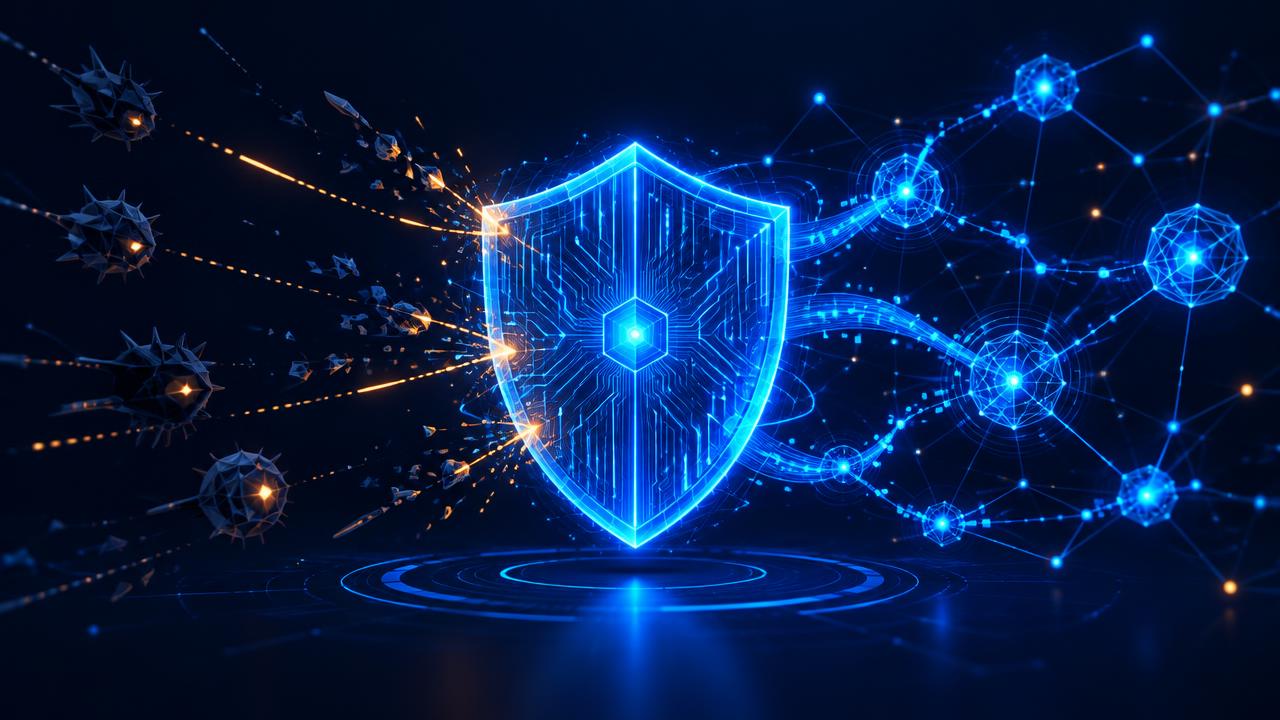
Published on RSA Conference official library: AI-driven threats move at machine speed, so security must shift from monitoring to autonomous response. Why self-healing systems that isolate, repair and recover on their own are now essential — and how intent, time and interaction put guardrails on defensive automation.
RSA Conference

Evidence-based trust, contextual reputation and risk-aware permissions between autonomous agents.
Personal technical perspective

Recognized among the National Capital Region's premier cybersecurity leaders advancing enterprise AI defense, autonomous agent security, and next-generation cyber resilience.
Business Insider / Markets Insider
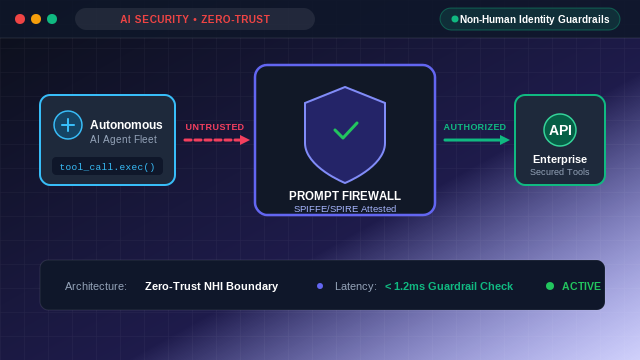
An owner-described approach to non-human identity, prompt boundaries and policy enforcement for multi-agent tool execution.
Public portfolio project