Published · Sep 2026
Beyond Models: Building Trusted AI in the Age of Autonomous Agents
Proceedings of the Raptors Conference (Raptors Conference 2026) • Vol. 1 (2026)
Author listed by source: Harsh Verma
- Publisher
- Hackathon Raptors (Raptors.Dev)
- Research area
- AI Security & Trust
- Publication date
- Sep 2026
- Status
- Published
- DOI
- 10.68495/rc.2026.C025
- Manuscript
- Not applicable
Abstract
Publisher abstractThis presentation introduces the emerging paradigm of multi-agentic AI in cybersecurity, where systems evolve from passive tools to autonomous decision-making entities. This explores the rise of agentic AI and its transformative impact on modern cybersecurity. As AI systems evolve from assistive tools into autonomous agents capable of independent decision-making and action, they introduce a new class of dynamic, fast-moving, and highly adaptive threats. The session examines the architecture and behavior of these agents, highlighting critical vulnerabilities that emerge from autonomy, orchestration, and trust dependencies. It presents the concept of a "lethal trifecta" of risks that redefine traditional security boundaries. Through practical scenarios, the workshop illustrates how adversarial agents exploit interconnected systems and data flows at scale. It then outlines a defense-first approach grounded in observability, governance, and secure infrastructure design, emphasizing a shift toward "secure-by-design" principles. The discussion also addresses the evolving balance between human oversight and machine autonomy. Participants will gain actionable frameworks to design resilient, trustworthy agentic systems and transition toward proactive, self-healing cybersecurity models. Published in Proceedings of the Raptors Conference , Vol. 1 (2026) Conference Raptors Conference 2026 , 21 October 2026, online Accepted 2026-09-12 DOI https://doi.org/10.68495/rc.2026.C025 Presentation Slides (PDF) Licence © 2026Harsh Verma. Published under Creative Commons Attribution 4.0 International (CC BY 4.0) . Publisher Hackathon Raptors, Community Interest Company 15557917, London, United Kingdom Permanent address https://proceedings.raptors.dev/verma-trusted-ai-autonomous-agents Open access. Every entry in the Proceedings is free to read, with no charge to authors and no charge to readers. Slides are served from this site, so they stay available at the paper's permanent address.
Full abstract reproduced from the publisher record. Original record ↗
Citation
Verma, H. (2026). Beyond Models: Building Trusted AI in the Age of Autonomous Agents. Proceedings of the Raptors Conference (Raptors Conference 2026) • Vol. 1 (2026). https://doi.org/10.68495/rc.2026.C025
Subject relationships
Inside the research.
An editorial topic map from this paper’s portfolio tags, not a diagram reproduced from the paper.
Part of the Connected Knowledge Graph
106 related works · 9 content types
Connected research & perspectives

ACM Sacramento Keynote: When Enterprises Become Multi-Agent Systems
Distinguished Keynote Address titled 'When Enterprises Become Multi-Agent Systems: Secure and Trustworthy Machine Learning & AI for Multi-Domain Applications', analyzing enterprise LLM defense, zero-trust validation, and autonomous agent alignment.
ACM Distinguished Keynote Session

Security Without Humans: Designing Systems that Defend Themselves
Published on RSA Conference official library: AI-driven threats move at machine speed, so security must shift from monitoring to autonomous response. Why self-healing systems that isolate, repair and recover on their own are now essential — and how intent, time and interaction put guardrails on defensive automation.
RSA Conference

Autonomous Cyber Defense
Detection, response and recovery with bounded autonomy and accountable oversight.
Personal technical perspective

Business Insider: Principal Software Engineer Harsh Verma Named a 2026 NVTC Cyber50 Executive Honoree
Recognized among the National Capital Region's premier cybersecurity leaders advancing enterprise AI defense, autonomous agent security, and next-generation cyber resilience.
Business Insider / Markets Insider
AI-Driven Cybersecurity in Software Engineering
Published · The rise in complexity of software systems and the rise in sophistication of cyber threats have led to cybersecurity becoming a key issue in software engineering. The conventional security systems are usually unable to capture and react to the current attacks in real time, especially in a large-scale and dynamic environment. The development of Artificial Intelligence (AI) has become a revolutionary solution due to its ability to detect threats intelligently, evaluate vulnerabilities automatically, perform predictive analytics, detect anomalies, and implement adaptive defense mechanisms. This paper will discuss AI-driven cybersecurity in the software engineering field, where machine learning, deep learning, natural language processing, and reinforcement learning can be applied throughout the software development lifecycle to provide increased security. The study assesses the efficacy of AI-powered technologies in secure coding, threat modeling, penetration testing, reviewing code, malware detection, and responding to an incident. It also examines issues like adversarial attacks, data privacy issues, bias in algorithms, explainability, and integration issues in current development pipelines. Based on a systematic review and comparative framework, the paper shows that AI-based cybersecurity can greatly enhance the ability to proactively defend against threats, decrease reaction time, and increase resilience in the face of new threats. The results highlight the importance of ethical governance, human control, and ongoing updates of models to maximize the advantages of AI in safe software engineering activities. The work can be regarded as a valuable roadmap to researchers and developers, as well as organizations aiming to deploy intelligent cybersecurity approaches to the contemporary software environment.
WJARR
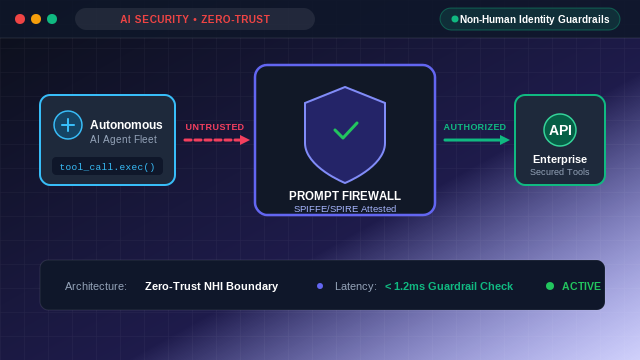
Agentic Security & NHI Guardrails
An owner-described approach to non-human identity, prompt boundaries and policy enforcement for multi-agent tool execution.
Public portfolio project