Reputation laundering
A low-trust agent delegates through a trusted agent. Preserve the initiating identity and delegation chain so the tool gateway evaluates the original authority, not just the final caller.
// research & expertise · personal technical perspective
Evidence-based trust, contextual reputation and risk-aware permissions between autonomous agents.

Research thesis
Stable identity does not prove safe intent, and a scalar reputation score can conceal task-specific weaknesses. Multi-agent systems need evidence provenance, accountability and protection against collusion or reputation laundering.
These are personal technical perspectives and proposed design patterns, not employer-endorsed architecture or claims of experimentally validated findings.
Identity → Behavior → Evidence → Reputation → Risk Evaluation → Authorization is a personal research model for discussion. It is not presented as a validated standard, published experimental result or employer architecture.
Record who observed a behavior, under what task conditions and with which verification. Evidence should distinguish a claimed success from an independently checked outcome and preserve uncertainty.
Evaluate an agent for a specific capability and risk class. Retrieval accuracy does not establish safe payment execution. Decay outdated evidence and reconsider trust after model, tool or policy changes.
Combine current action risk with policy, identity and evidence. Reputation may influence the level of review but must not override hard security constraints or authorize access the caller does not possess.
A low-trust agent delegates through a trusted agent. Preserve the initiating identity and delegation chain so the tool gateway evaluates the original authority, not just the final caller.
An agent with reliable read-only performance requests a destructive operation. Require a new risk assessment and appropriate approval rather than treating accumulated success as universal permission.
Part of the Connected Knowledge Graph
83 related works · 8 content types

An architectural examination of the fundamental tension between contextual user personalization and enterprise zero-trust data privacy in modern retrieval and agent ecosystems.
Forbes Council

Detection, response and recovery with bounded autonomy and accountable oversight.
Personal technical perspective

Deep-dive executive presentation covering enterprise AI architectures, scaling multi-agent workloads, identity boundaries, and real-time behavioral defense.
TechTalk with VLink Keynote (Ep. 55)
Building an AI framework without comprehensive observability is like flying a supersonic jet without instruments.
NewsBreak / MarketersMedia
Published · Autonomous multi-agent artificial intelligence (AI) systems have emerged as a rapidly evolving field that revolutionizes the way autonomous systems can make decisions together, collaborate on tasks, and learn, thereby opening new paradigms for distributed decision-making, task execution, and adaptive learning. The complexity of these systems, however, brings in several serious security issues due to the dependency of the autonomous agents. In contrast, vulnerabilities in multi-agent systems are no longer bound to their individual agents, but are spread across the system through their trust-based interactions, leading to systemic risks that can't be adequately identified or protected using traditional security methods. These emerging risks underscore the importance of a structured approach that can account for trust as a fluid and security-sensitive factor in interdependent AI systems. In order to tackle this challenge, this paper proposes a novel graph-based approach to the representation of trust relationships and vulnerability propagation in multi-agent AI systems, called the Emergent Trust Vulnerability Graph (ETVG). Furthermore, the study introduces an Agentic Trust Dynamics Theory (ATDT) as a conceptual theory to model the evolution, loss, and impact of trust on emerging security vulnerabilities in an autonomous agent network. These contributions form a framework for structuring the analysis of systemic risks that emerge from interactions between agents, and not from the failure of individual agents. Methodologically, the proposed framework utilizes the most commonly used graph modeling techniques in which an agent is modeled as a node and trust is modeled as a weight on the edges. The influence and compromise propagation through connected agents is simulated using trust propagation analysis. Controlled simulation experiments are conducted, utilizing multi-agent coordination environments with different degrees of adversarial interference and trust manipulation scenarios, in order to validate the model. The experimental results show that the ETVG framework achieves a high accuracy in vulnerability detection and mitigates the cascading effect of compromise across agent networks. In addition, the proposed model improves the capability of trust-risk prediction, which is able to discover high-risk nodes in complex interaction structures effectively. The framework exhibits better performance in maintaining the stability of the system under attack, as compared with conventional baseline approaches. This work is important for the understanding of the fundamental problems of security in autonomous AI environments. This study offers new means to design a resilient multi-agent system that is able to resist emergent threats by formalizing trust as a dynamic security vector. The results also point to promising avenues for future research in developing secure, adaptive, and self-regulating infrastructures for AI agents
IJSRM
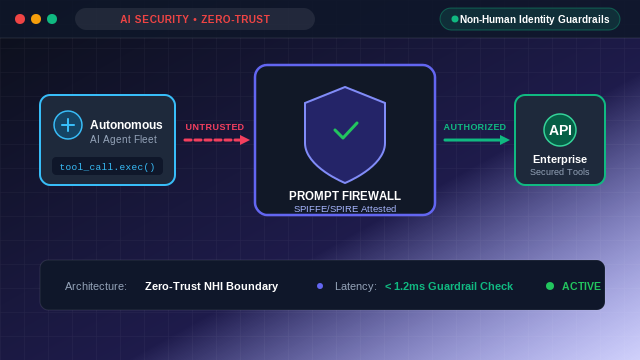
An owner-described approach to non-human identity, prompt boundaries and policy enforcement for multi-agent tool execution.
Public portfolio project