Published · 2026
Security in Multi-Agent AI Systems: Modeling Emergent Vulnerabilities via Trust Graphs
International Journal of Scientific Research and Management (IJSRM) • Vol. 14, No. 4 (2026)
Author listed by source: Harsh Verma
- Publisher
- IJSRM
- Research area
- AI Security & Trust
- Publication date
- 2026
- Status
- Published
- DOI
- 10.18535/ijsrm/v14i04.ec04
- Manuscript
- Not applicable
Abstract
Publisher abstractAutonomous multi-agent artificial intelligence (AI) systems have emerged as a rapidly evolving field that revolutionizes the way autonomous systems can make decisions together, collaborate on tasks, and learn, thereby opening new paradigms for distributed decision-making, task execution, and adaptive learning. The complexity of these systems, however, brings in several serious security issues due to the dependency of the autonomous agents. In contrast, vulnerabilities in multi-agent systems are no longer bound to their individual agents, but are spread across the system through their trust-based interactions, leading to systemic risks that can't be adequately identified or protected using traditional security methods. These emerging risks underscore the importance of a structured approach that can account for trust as a fluid and security-sensitive factor in interdependent AI systems. In order to tackle this challenge, this paper proposes a novel graph-based approach to the representation of trust relationships and vulnerability propagation in multi-agent AI systems, called the Emergent Trust Vulnerability Graph (ETVG). Furthermore, the study introduces an Agentic Trust Dynamics Theory (ATDT) as a conceptual theory to model the evolution, loss, and impact of trust on emerging security vulnerabilities in an autonomous agent network. These contributions form a framework for structuring the analysis of systemic risks that emerge from interactions between agents, and not from the failure of individual agents. Methodologically, the proposed framework utilizes the most commonly used graph modeling techniques in which an agent is modeled as a node and trust is modeled as a weight on the edges. The influence and compromise propagation through connected agents is simulated using trust propagation analysis. Controlled simulation experiments are conducted, utilizing multi-agent coordination environments with different degrees of adversarial interference and trust manipulation scenarios, in order to validate the model. The experimental results show that the ETVG framework achieves a high accuracy in vulnerability detection and mitigates the cascading effect of compromise across agent networks. In addition, the proposed model improves the capability of trust-risk prediction, which is able to discover high-risk nodes in complex interaction structures effectively. The framework exhibits better performance in maintaining the stability of the system under attack, as compared with conventional baseline approaches. This work is important for the understanding of the fundamental problems of security in autonomous AI environments. This study offers new means to design a resilient multi-agent system that is able to resist emergent threats by formalizing trust as a dynamic security vector. The results also point to promising avenues for future research in developing secure, adaptive, and self-regulating infrastructures for AI agents
Full abstract reproduced from the publisher record. Original record ↗
Citation
Verma, H. (2026). Security in Multi-Agent AI Systems: Modeling Emergent Vulnerabilities via Trust Graphs. International Journal of Scientific Research and Management (IJSRM) • Vol. 14, No. 4 (2026). https://doi.org/10.18535/ijsrm/v14i04.ec04
Subject relationships
Inside the research.
An editorial topic map from this paper’s portfolio tags, not a diagram reproduced from the paper.
Part of the Connected Knowledge Graph
106 related works · 9 content types
Connected research & perspectives

Personalized AI Systems: The Hidden Trade-Off Behind Smarter AI (Personalization vs. Privacy)
An architectural examination of the fundamental tension between contextual user personalization and enterprise zero-trust data privacy in modern retrieval and agent ecosystems.
Forbes Council
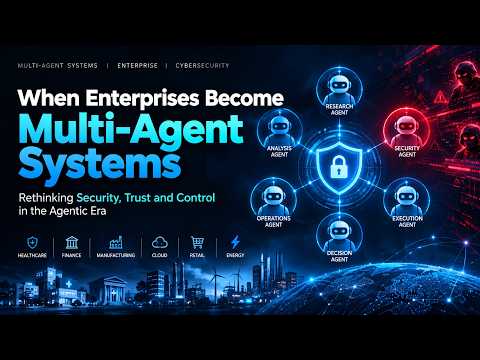
ACM Sacramento Keynote: When Enterprises Become Multi-Agent Systems
Distinguished Keynote Address titled 'When Enterprises Become Multi-Agent Systems: Secure and Trustworthy Machine Learning & AI for Multi-Domain Applications', analyzing enterprise LLM defense, zero-trust validation, and autonomous agent alignment.
ACM Distinguished Keynote Session
Clean Attacks: Formalizing Semantically Valid Adversarial Behavior in Autonomous AI Agent Systems
Published · Defines and categorizes 'Clean Attacks'—adversarial inputs that bypass syntactical and semantic guardrails by strictly obeying schema and policy specifications while manipulating agent objective functions.
IJSRM

Agent Trust & Reputation
Evidence-based trust, contextual reputation and risk-aware permissions between autonomous agents.
Personal technical perspective

Business Insider: Principal Software Engineer Harsh Verma Named a 2026 NVTC Cyber50 Executive Honoree
Recognized among the National Capital Region's premier cybersecurity leaders advancing enterprise AI defense, autonomous agent security, and next-generation cyber resilience.
Business Insider / Markets Insider
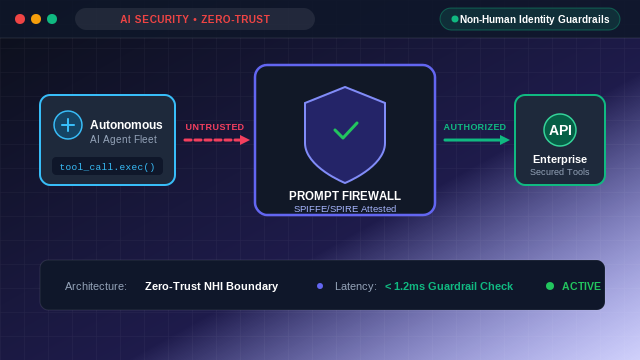
Agentic Security & NHI Guardrails
An owner-described approach to non-human identity, prompt boundaries and policy enforcement for multi-agent tool execution.
Public portfolio project