Injected instruction in a retrieved document
A document asks the agent to export customer data. Treat it as untrusted content; a policy gateway should deny export even if the planner attempts the tool call.
// research & expertise · personal technical perspective
Identity, least privilege and runtime controls for agents operating across enterprise boundaries.

Research thesis
An authenticated agent can execute a harmful action using legitimate tools. Prompt injection, excessive permissions and confused-deputy behavior make model-level filtering insufficient as the sole security control.
These are personal technical perspectives and proposed design patterns, not employer-endorsed architecture or claims of experimentally validated findings.
Issue short-lived, scoped credentials and separate read from write authority. A tool gateway checks the target resource, action and current user context independently of what the model claims.
Retrieved documents, websites and tool responses can contain malicious instructions. Preserve provenance and separate data from system policy. Sanitize rendering, constrain tools and do not rely on the model to maintain trust boundaries alone.
Approval should bind to the exact action and important arguments. If the agent changes the recipient, resource or amount after approval, the original approval must not authorize the modified action.
Assign an accountable owner, retain appropriate action records and test incident recovery. Document which decisions may be automated, which require review and who can suspend a deployment.
A document asks the agent to export customer data. Treat it as untrusted content; a policy gateway should deny export even if the planner attempts the tool call.
An approved change is redirected to another resource. Bind approval to immutable action details and expire it after use.
Part of the Connected Knowledge Graph
81 related works · 8 content types

A practical enterprise AI agent security checklist covering least-privilege tools, action-bound approvals, prompt injection, audit trails and runtime containment.
iamharshverma.com

Evidence-based trust, contextual reputation and risk-aware permissions between autonomous agents.
Personal technical perspective
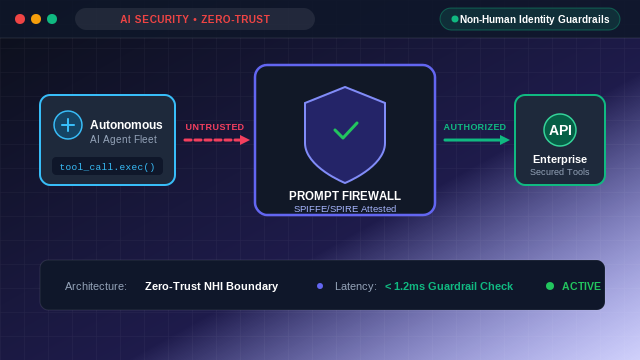
An owner-described approach to non-human identity, prompt boundaries and policy enforcement for multi-agent tool execution.
Public portfolio project

Deep-dive executive presentation covering enterprise AI architectures, scaling multi-agent workloads, identity boundaries, and real-time behavioral defense.
TechTalk with VLink Keynote (Ep. 55)

Recognized among the National Capital Region's premier cybersecurity leaders advancing enterprise AI defense, autonomous agent security, and next-generation cyber resilience.
Business Insider / Markets Insider
Published · Autonomous multi-agent artificial intelligence (AI) systems have emerged as a rapidly evolving field that revolutionizes the way autonomous systems can make decisions together, collaborate on tasks, and learn, thereby opening new paradigms for distributed decision-making, task execution, and adaptive learning. The complexity of these systems, however, brings in several serious security issues due to the dependency of the autonomous agents. In contrast, vulnerabilities in multi-agent systems are no longer bound to their individual agents, but are spread across the system through their trust-based interactions, leading to systemic risks that can't be adequately identified or protected using traditional security methods. These emerging risks underscore the importance of a structured approach that can account for trust as a fluid and security-sensitive factor in interdependent AI systems. In order to tackle this challenge, this paper proposes a novel graph-based approach to the representation of trust relationships and vulnerability propagation in multi-agent AI systems, called the Emergent Trust Vulnerability Graph (ETVG). Furthermore, the study introduces an Agentic Trust Dynamics Theory (ATDT) as a conceptual theory to model the evolution, loss, and impact of trust on emerging security vulnerabilities in an autonomous agent network. These contributions form a framework for structuring the analysis of systemic risks that emerge from interactions between agents, and not from the failure of individual agents. Methodologically, the proposed framework utilizes the most commonly used graph modeling techniques in which an agent is modeled as a node and trust is modeled as a weight on the edges. The influence and compromise propagation through connected agents is simulated using trust propagation analysis. Controlled simulation experiments are conducted, utilizing multi-agent coordination environments with different degrees of adversarial interference and trust manipulation scenarios, in order to validate the model. The experimental results show that the ETVG framework achieves a high accuracy in vulnerability detection and mitigates the cascading effect of compromise across agent networks. In addition, the proposed model improves the capability of trust-risk prediction, which is able to discover high-risk nodes in complex interaction structures effectively. The framework exhibits better performance in maintaining the stability of the system under attack, as compared with conventional baseline approaches. This work is important for the understanding of the fundamental problems of security in autonomous AI environments. This study offers new means to design a resilient multi-agent system that is able to resist emergent threats by formalizing trust as a dynamic security vector. The results also point to promising avenues for future research in developing secure, adaptive, and self-regulating infrastructures for AI agents
IJSRM