
Harsh

// recorded keynote · xRaised Global Leadership Series

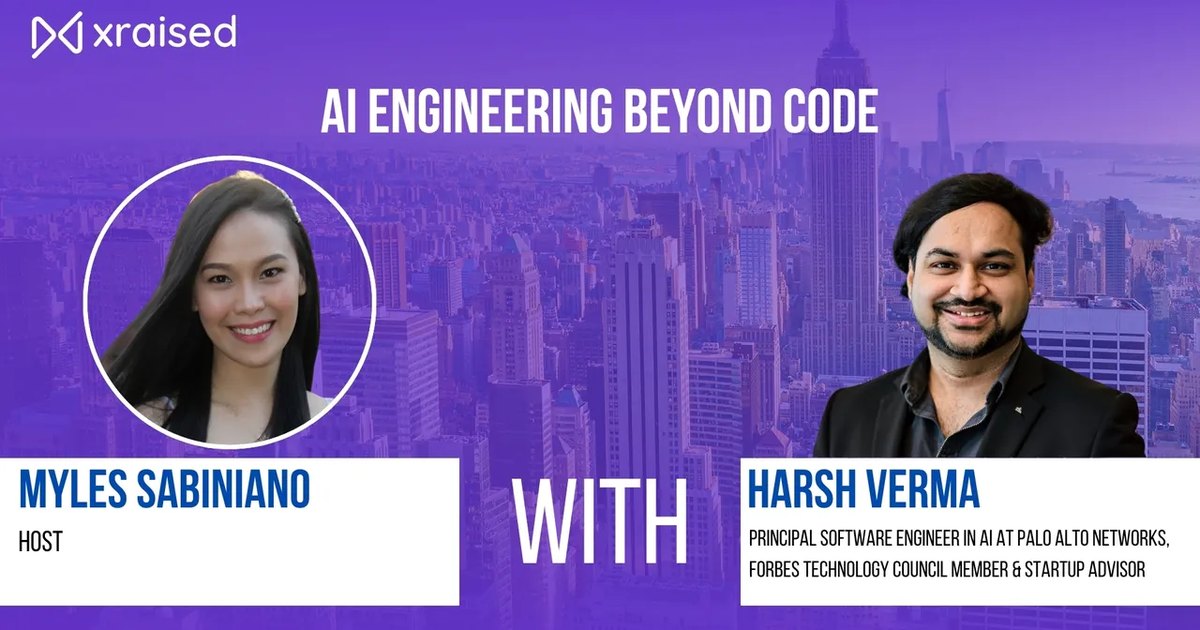
xRaised Global Leadership: AI Engineering Beyond Code

Executive keynote interview with Harsh Verma on 'Beyond the Code: The Evolution of the Next-Generation Engineer' — exploring autonomous agent architectures, multi-model production scaling, engineering leadership, and proactive cybersecurity in frontier AI syst

FounderEngineerSpeaker
xRaised Global Leadership: AI Engineering Beyond Code

Connected perspectives

Part of the Connected Knowledge Graph

122 related works · 9 content types

Explore connections
Security Without Humans: Designing Systems that Defend Themselves
Article · 2026Explore

Security Without Humans: Designing Systems that Defend Themselves

Published on RSA Conference official library: AI-driven threats move at machine speed, so security must shift from monitoring to autonomous response. Why self-healing systems that isolate, repair and recover on their own are now essential — and how intent, time and interaction put guardrails on defensive automation.

RSA Conference
Security in Multi-Agent AI Systems: Modeling Emergent Vulnerabilities via Trust Graphs
Publication · 2026Explore

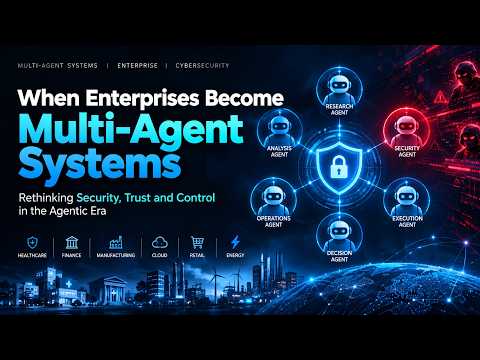
Security in Multi-Agent AI Systems: Modeling Emergent Vulnerabilities via Trust Graphs

Published · Autonomous multi-agent artificial intelligence (AI) systems have emerged as a rapidly evolving field that revolutionizes the way autonomous systems can make decisions together, collaborate on tasks, and learn, thereby opening new paradigms for distributed decision-making, task execution, and adaptive learning. The complexity of these systems, however, brings in several serious security issues due to the dependency of the autonomous agents. In contrast, vulnerabilities in multi-agent systems are no longer bound to their individual agents, but are spread across the system through their trust-based interactions, leading to systemic risks that can't be adequately identified or protected using traditional security methods. These emerging risks underscore the importance of a structured approach that can account for trust as a fluid and security-sensitive factor in interdependent AI systems. In order to tackle this challenge, this paper proposes a novel graph-based approach to the representation of trust relationships and vulnerability propagation in multi-agent AI systems, called the Emergent Trust Vulnerability Graph (ETVG). Furthermore, the study introduces an Agentic Trust Dynamics Theory (ATDT) as a conceptual theory to model the evolution, loss, and impact of trust on emerging security vulnerabilities in an autonomous agent network. These contributions form a framework for structuring the analysis of systemic risks that emerge from interactions between agents, and not from the failure of individual agents. Methodologically, the proposed framework utilizes the most commonly used graph modeling techniques in which an agent is modeled as a node and trust is modeled as a weight on the edges. The influence and compromise propagation through connected agents is simulated using trust propagation analysis. Controlled simulation experiments are conducted, utilizing multi-agent coordination environments with different degrees of adversarial interference and trust manipulation scenarios, in order to validate the model. The experimental results show that the ETVG framework achieves a high accuracy in vulnerability detection and mitigates the cascading effect of compromise across agent networks. In addition, the proposed model improves the capability of trust-risk prediction, which is able to discover high-risk nodes in complex interaction structures effectively. The framework exhibits better performance in maintaining the stability of the system under attack, as compared with conventional baseline approaches. This work is important for the understanding of the fundamental problems of security in autonomous AI environments. This study offers new means to design a resilient multi-agent system that is able to resist emergent threats by formalizing trust as a dynamic security vector. The results also point to promising avenues for future research in developing secure, adaptive, and self-regulating infrastructures for AI agents

IJSRM

Agentic AI Architecture
ResearchExplore

Agentic AI Architecture

Orchestration, coordination and evaluation for systems that plan, use tools and act.

Personal technical perspective

Book Harsh