Published · 2024
AI Agentic Architectures for Autonomous Data Engineering Pipelines
International Journal of Research and Applied Innovations (IJRAI) • Vol. 7, No. 6 (2024)
Author listed by source: Harsh Verma
- Publisher
- IJRAI
- Research area
- AI Agentic Systems
- Publication date
- 2024
- Status
- Published
- DOI
- 10.15662/IJRAI.2024.0706041
- Manuscript
- Not applicable
Abstract
Publisher abstractTremendous advances have been made in big data technologies, cloud computing, and artificial intelligence, which have dramatically changed the way engineers work today. The limitations of traditional data engineering pipelines are manual dependency, static workflow orchestration, and rule-based monitoring mechanisms, restricting scalability, flexibility, and efficiency in dynamic computing environments. With the processing of large amounts of structured and unstructured data, there is a growing need for intelligent and autonomous data processing systems that require minimal human involvement in data pipeline management. This study delves into the notion of AI agentic architectures for autonomous data engineering pipelines and investigates the potential benefits of intelligent agents in enhancing automation, resilience, and decision-making processes in contemporary data ecosystems The research is focused on the design and evaluation of an Agent-based architecture that could be capable of performing critical data engineering tasks (data ingestion, data validation, data orchestration, data monitoring, data optimization, and fault recovery) autonomously. The study is conducted with a hybrid method combining architectural modeling, comparison, and evaluation through simulation with current AI and cloud technologies. The suggested framework incorporates autonomous AI agents, machine learning algorithms, and intelligent orchestration mechanisms to facilitate adaptive and self-healing operations of pipelines
Full abstract reproduced from the publisher record. Original record ↗
Citation
Verma, H. (2024). AI Agentic Architectures for Autonomous Data Engineering Pipelines. International Journal of Research and Applied Innovations (IJRAI) • Vol. 7, No. 6 (2024). https://doi.org/10.15662/IJRAI.2024.0706041
Subject relationships
Inside the research.
An editorial topic map from this paper’s portfolio tags, not a diagram reproduced from the paper.
Part of the Connected Knowledge Graph
102 related works · 9 content types
Connected research & perspectives
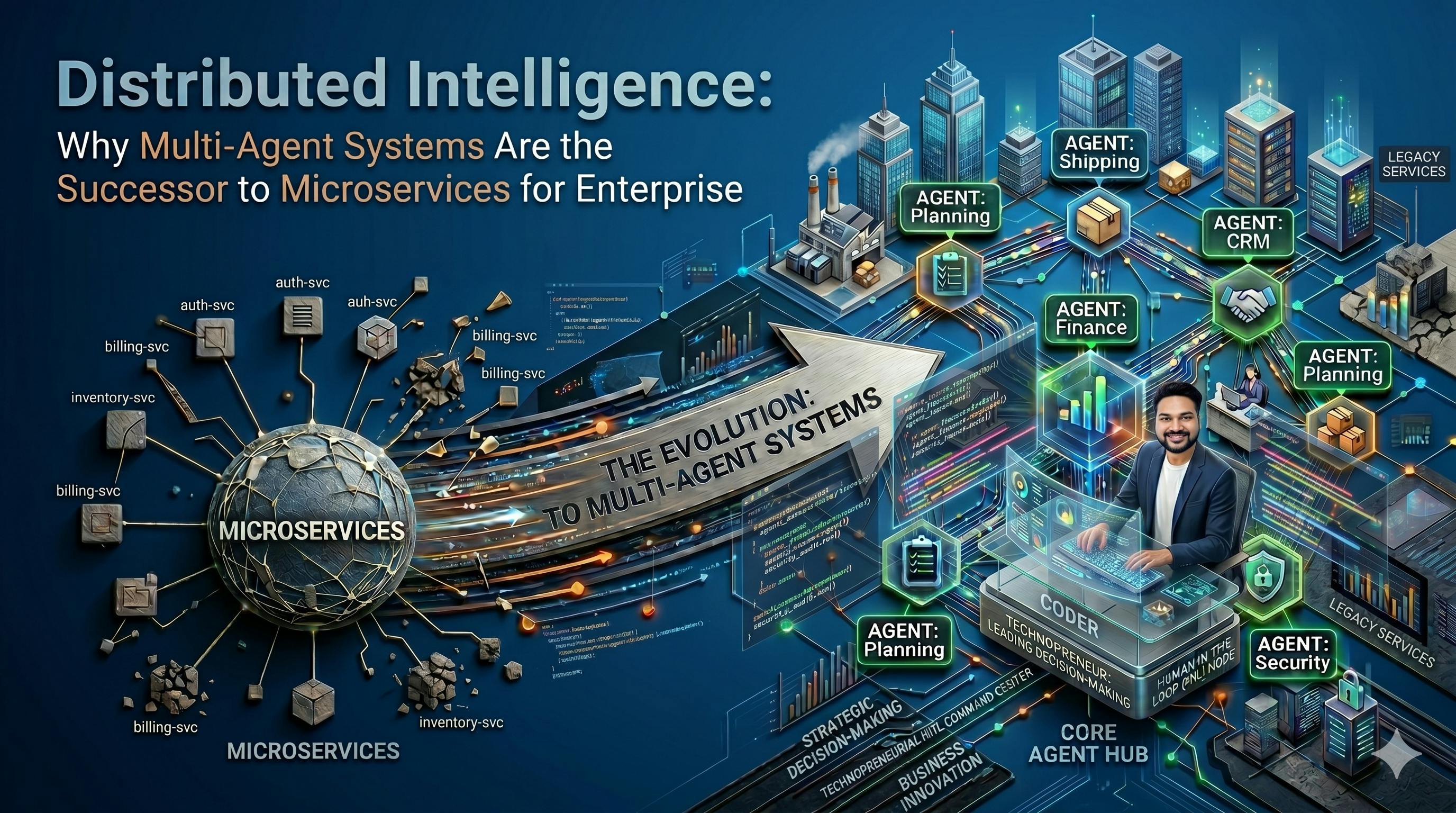
Distributed Intelligence: Why Multi-Agent Systems Are the Successor to Microservices
Just as microservices decomposed monolithic codebases, autonomous multi-agent networks are decomposing complex reasoning workflows into distributed, collaborative nodes.
HackerNoon
Autonomous Multi-Agent Systems for Enterprise Decision-Making
Published · Introduces a collaborative multi-agent voting and deliberation hierarchy designed for high-consequence enterprise decision scenarios, ensuring consensus formation, verification, and auditability across heterogeneous models.
IJEETR

Agentic AI Architecture
Orchestration, coordination and evaluation for systems that plan, use tools and act.
Personal technical perspective

A Custom Java Hash Table
A source-based review of separate chaining, map operations and the correctness lessons in a public educational implementation.
Public source review

Beyond AI Engineering
AI can increasingly write the implementation. Your advantage moves to judgment. A career operating system for the agentic AI era — moving from Creator to Architect to Orchestrator.
Harsh Verma

ACM Sacramento Keynote: When Enterprises Become Multi-Agent Systems
Distinguished Keynote Address titled 'When Enterprises Become Multi-Agent Systems: Secure and Trustworthy Machine Learning & AI for Multi-Domain Applications', analyzing enterprise LLM defense, zero-trust validation, and autonomous agent alignment.
ACM Distinguished Keynote Session