
Java · Repository reference · Not a measured production result
- 01Key hash
- 02Bucket index
- 03Linked collision chain
- 04Insert / lookup / remove
Project overview
This public educational Java implementation models a key-value map. The review describes inspectable source code, not a production system, employer project or benchmarked library.
Engineering challenge
Hash collisions require a strategy for storing and finding multiple keys in one bucket. Correctness also depends on update semantics, missing-key handling and keeping the reported size consistent with stored entries.
Architecture and data flow
Main.CustomHashMap initializes ten bucket entries in a Vector. DataNodeHavingKeyAndValue nodes form linked chains. The bucket index is calculated from key.hashCode() modulo the configured bucket count.
Engineering decisions
Separate chaining makes collisions explicit. addkeyInBucket searches the chain, updates a matching key or prepends a node; getValueFromBucketListBasedOnGivenKeyInput searches for a key; remove unlinks a node. This favors a readable teaching implementation over a feature-complete standard-library replacement.
Implementation and evaluation
The main method exercises string-key insertion and removal. Useful regression cases include repeated updates, absent-key removal, negative hash codes and long collision chains. The repository demonstration is not evidence of comprehensive testing or a measured performance result.
Security and reliability
The source does not establish thread safety or lock freedom. Vector does not make multi-step map operations atomic. Capacity growth is not rehashing, negative modulo results can produce invalid indexes and null keys are not handled. Updating an existing key increments size, while some unsuccessful removals decrement it.
Outcomes, lessons and limitations
The inspectable result is a small map implementation and a concrete set of correctness trade-offs. Proposed improvements include normalized bucket indexes, invariant-preserving size updates, explicit resizing and targeted tests. No throughput, scale or production reliability claim is made.
Source and reproducibility
Inspect the public implementation ↗Reviewed November 21, 2026. HEAD follows the repository's current version; subsequent code changes may differ from this review.
Related perspectives
Part of the Connected Knowledge Graph
92 related works · 9 content types

Distributed Intelligence: Why Multi-Agent Systems Are the Successor to Microservices
Just as microservices decomposed monolithic codebases, autonomous multi-agent networks are decomposing complex reasoning workflows into distributed, collaborative nodes.
HackerNoon

Distributed AI Systems
Resilient data pipelines, shared state and scalable infrastructure for enterprise intelligence.
Personal technical perspective
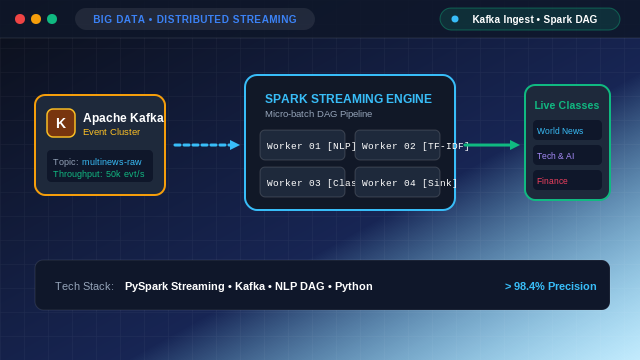
PySpark Streaming MultiNews Classification
A public project exploring streaming news processing and topic classification with PySpark.
Public portfolio project