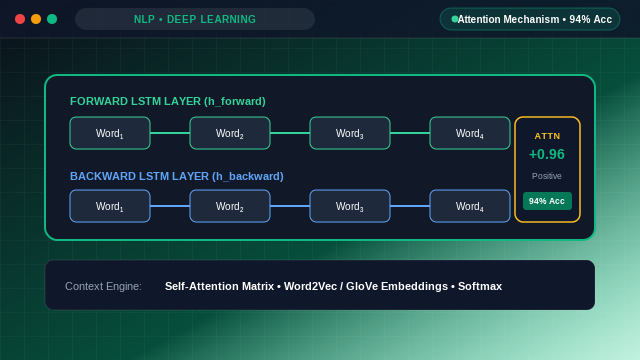
BiLSTM · NLP · Sentiment · Repository reference · Not a measured production result
- 01Text input
- 02Token representation
- 03Bidirectional model
- 04Sentiment score
- 05Evaluation
Project overview
A contextual sentiment-analysis project using bidirectional sequence modeling.
Architecture perspective
Explore how context, negation and sequence representations influence sentiment predictions. Keep training and evaluation splits independent and inspect difficult or ambiguous examples.
Source and validation boundaries
Attention mechanisms and framework details are described by the source portfolio, not independently validated here. No accuracy or deployment claim is made.
Explore the implementation
This project is listed on Harsh Verma’s public portfolio (https://www.harshverma.me/page-portfolio). Follow the repository reference below to inspect available code, setup instructions and reproducible examples. The flow above is a conceptual reading guide, not a claim of verified runtime behavior.
Source and reproducibility
Explore the public repository reference ↗Listed on the author’s public portfolio. Architecture descriptions and original thumbnails are owner-provided; implementation details and performance are not independently verified.
Related perspectives
Part of the Connected Knowledge Graph
87 related works · 9 content types

Security Without Humans: Designing Systems that Defend Themselves
Published on RSA Conference official library: AI-driven threats move at machine speed, so security must shift from monitoring to autonomous response. Why self-healing systems that isolate, repair and recover on their own are now essential — and how intent, time and interaction put guardrails on defensive automation.
RSA Conference

Agentic AI Architecture
Orchestration, coordination and evaluation for systems that plan, use tools and act.
Personal technical perspective

A Custom Java Hash Table
A source-based review of separate chaining, map operations and the correctness lessons in a public educational implementation.
Public source review