Published · 2025
Economic Impact and Productivity Modeling of AI Agents
World Journal of Advanced Research and Reviews (WJARR) • Vol. 26, No. 3 (2025)
Author listed by source: Harsh Verma
- Publisher
- WJARR
- Research area
- AI Agentic Systems
- Publication date
- 2025
- Status
- Published
- DOI
- 10.30574/wjarr.2025.26.3.2304
- Manuscript
- Not applicable
Abstract
Publisher abstractThe spread of artificial intelligence (AI) agents in the economy inevitably asks questions about productivity and the shifts in the labour market and long-run macroeconomic growth. This paper, using a mixed-methods approach, pools microeconomic experimental evidence and macroeconomic modelling, for a thorough assessment of the economic impact of AI agents. The paper reports on four pioneering RCTs that randomized 6,478 workers in writing, coding, customer-service, and management-consulting domains showing a strong skill-levelling effect: Across various industries, overall productivity gains from AI agents range from 14% to 56%, with the majority of these gains occurring at the bottom of the talent distribution and only small or negative effects at the top. The modelling and simulation indicate that macroeconomic benefits will be achieved using a J-curve path and will result from a downward trend in the short term, followed by a long upward trend provided complementary investment is made. Based on macroeconomic forecasts from various organizations, the range of potential potential impacts of the EV transition is wide from +0.5% cumulative GDP growth (Acemoglu, 2024) to +7% cumulative GDP growth over a decade (Goldman Sachs) and +$25.6 trillion value added across industries (McKinsey, 2023). Analysis of the distribution of the labour supply shows that around 19% to 47% of workers are potentially highly affected in terms of the disruption of their tasks, including the relatively high exposure for high-education workers in routine cognitive occupations. The paper provides a comprehensive analytical tool to make sense of micro and macro evidence, unpacks scenarios when AI agents will drive inclusive productivity growth, and outlines a policy roadmap focused on complementary investments, incentives for task-redesign, and workforce transition support measures.
Full abstract reproduced from the publisher record. Original record ↗
Citation
Verma, H. (2025). Economic Impact and Productivity Modeling of AI Agents. World Journal of Advanced Research and Reviews (WJARR) • Vol. 26, No. 3 (2025). https://doi.org/10.30574/wjarr.2025.26.3.2304
Subject relationships
Inside the research.
An editorial topic map from this paper’s portfolio tags, not a diagram reproduced from the paper.
Part of the Connected Knowledge Graph
99 related works · 9 content types
Connected research & perspectives

Security Without Humans: Designing Systems that Defend Themselves
Published on RSA Conference official library: AI-driven threats move at machine speed, so security must shift from monitoring to autonomous response. Why self-healing systems that isolate, repair and recover on their own are now essential — and how intent, time and interaction put guardrails on defensive automation.
RSA Conference

Agentic AI Architecture
Orchestration, coordination and evaluation for systems that plan, use tools and act.
Personal technical perspective

Beyond AI Engineering
AI can increasingly write the implementation. Your advantage moves to judgment. A career operating system for the agentic AI era — moving from Creator to Architect to Orchestrator.
Harsh Verma
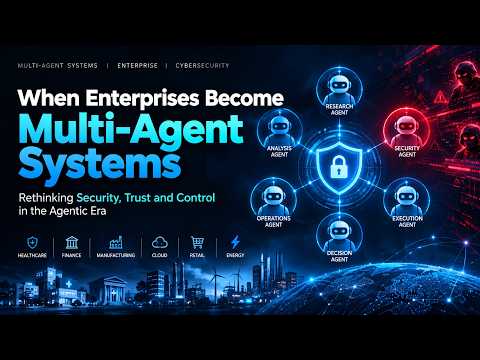
ACM Sacramento Keynote: When Enterprises Become Multi-Agent Systems
Distinguished Keynote Address titled 'When Enterprises Become Multi-Agent Systems: Secure and Trustworthy Machine Learning & AI for Multi-Domain Applications', analyzing enterprise LLM defense, zero-trust validation, and autonomous agent alignment.
ACM Distinguished Keynote Session

Business Insider: Principal Software Engineer Harsh Verma Named a 2026 NVTC Cyber50 Executive Honoree
Recognized among the National Capital Region's premier cybersecurity leaders advancing enterprise AI defense, autonomous agent security, and next-generation cyber resilience.
Business Insider / Markets Insider
Agentic AI, Enterprise Copilot Systems & Copilot Navigation
Foundational IP in autonomous agent orchestration and copilot reasoning loops. 4 pending · Assignee: Palo Alto Networks
4 pending · Assignee: Palo Alto Networks