Agentic AI · iamharshverma.com · November 20, 2026 · 12 min read
Judging Google Cloud's Agents for Impact Hackathon as a Google Developer Expert
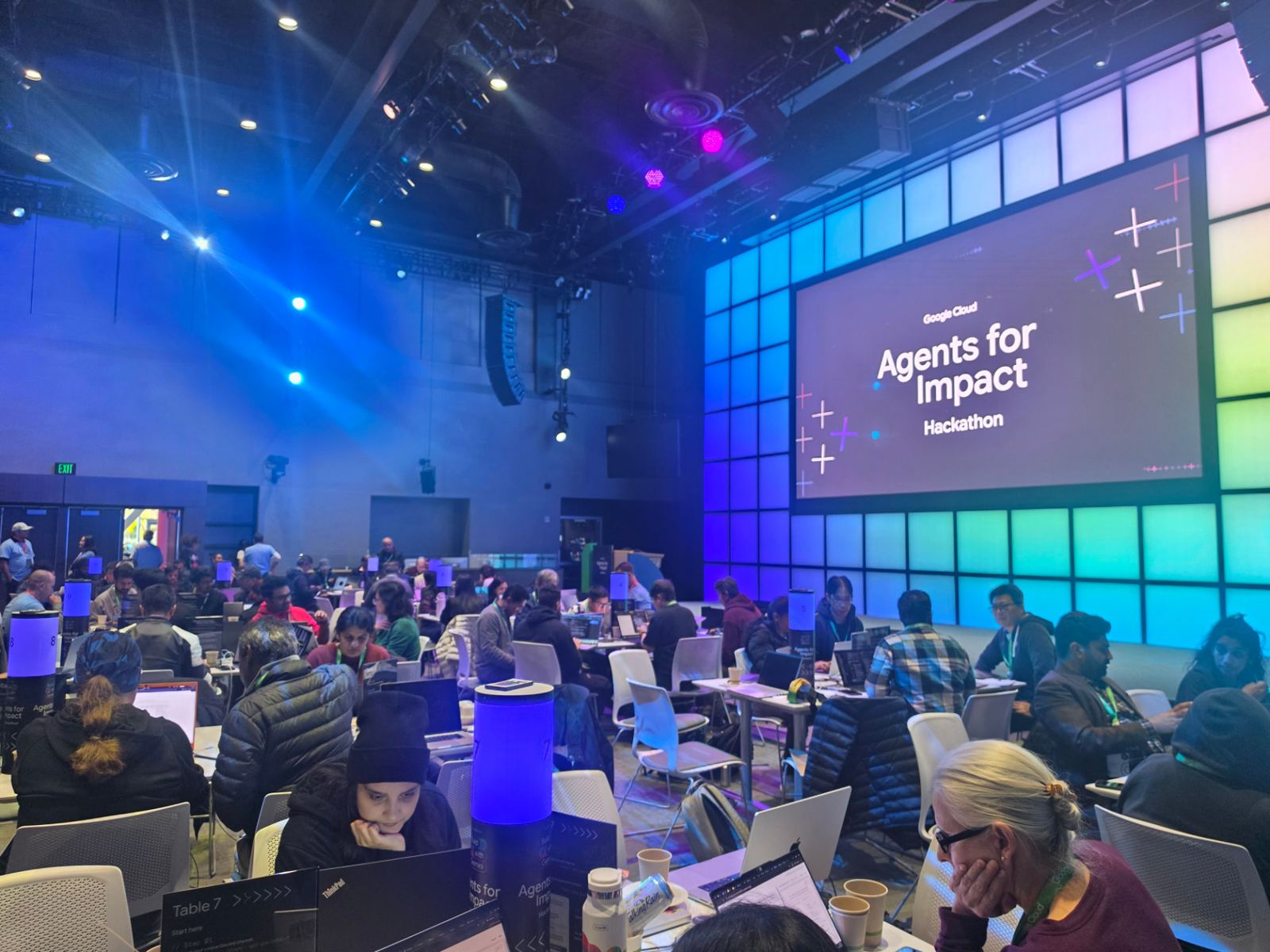
What I learned judging Google Cloud's Agents for Impact Hackathon in Sunnyvale as a Google Cloud AI Developer Expert: the creativity, the energy in the room, and how the best teams turned urban heat data into agents a city could actually use.
On November 17, 2026 I spent the day at the Google Event Center in Sunnyvale as a judge for Google Cloud's Agents for Impact Hackathon. As a Google Cloud AI Developer Expert, I get to see a lot of AI demos. Very few days pack this much learning, creativity and raw builder energy into ten hours.
The format was simple and demanding: one day, curated teams, real public datasets and Google's newest agentic stack, including Antigravity, the Agent Development Kit (ADK), Gemini models and BigQuery. One winning team advances to the AI Arena, where a live audience votes to send a team to the stage at Google Cloud Next '27.
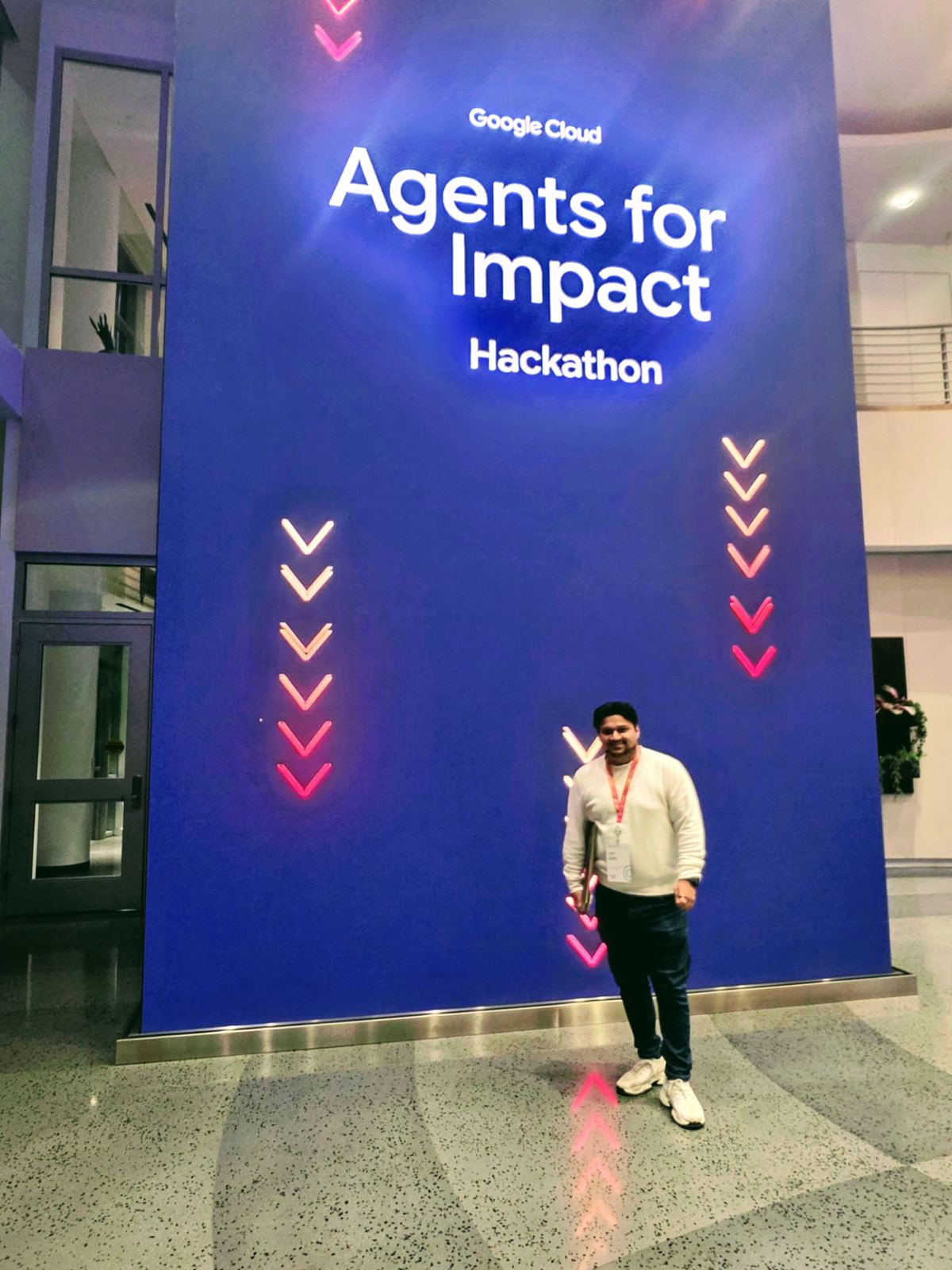
The problem: heat, block by block
The challenge I judged was Community Climate Resilience: Urban Heat. Heat is the deadliest weather in America, and also the most unequal. Two blocks in the same city can differ by more than fifteen degrees at the same hour. A city has a small budget, a hot summer coming and a decision to make about where to put help.
Teams worked with NOAA Heat Watch street-level readings plus years of weather-station history. The brief asked for an agent that predicts how much hotter a specific spot runs than the rest of the city, calls that prediction for places nobody ever measured, and turns it into a recommendation a city council can act on.
The ambience and the energy
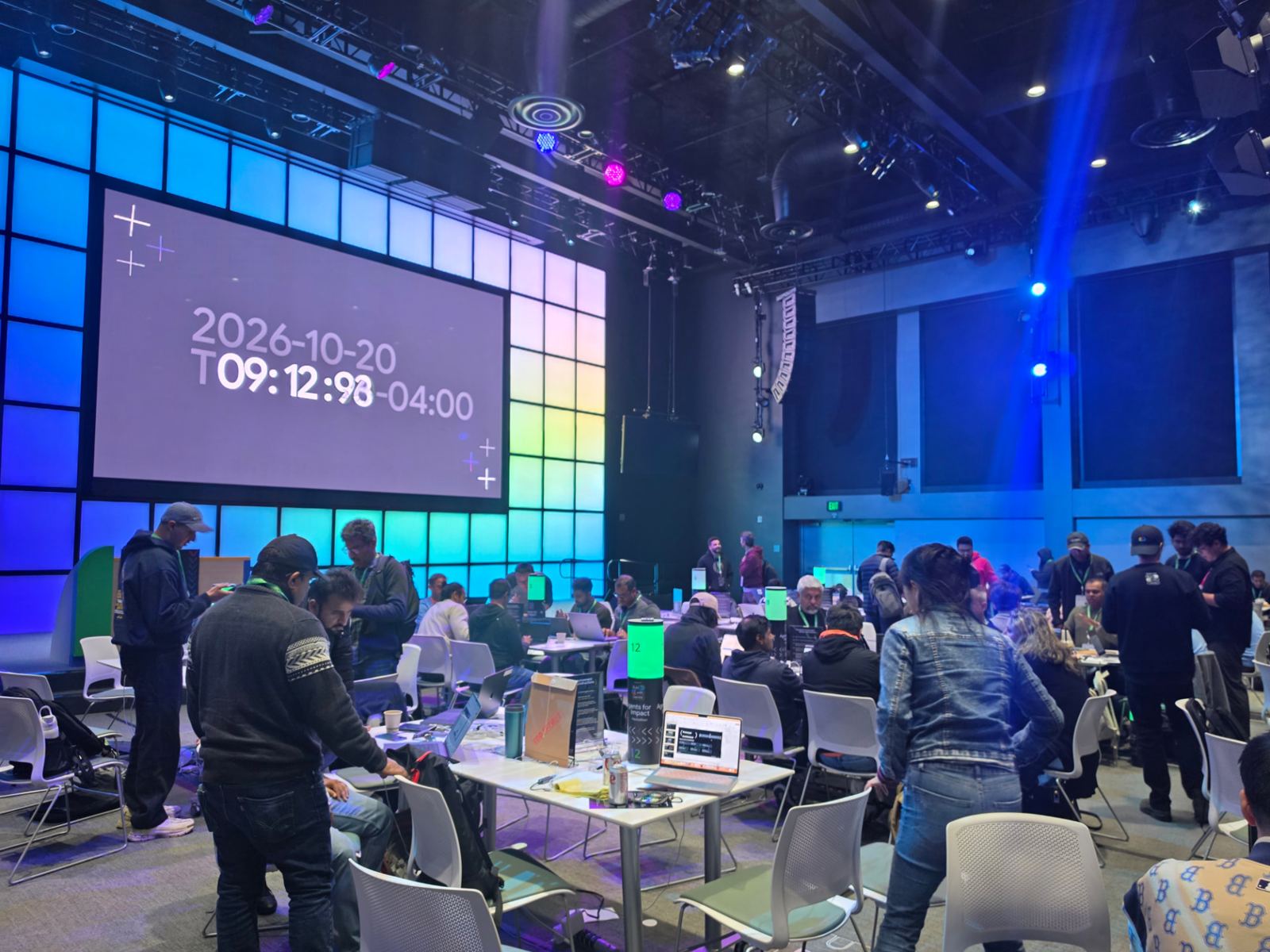
The hall felt like a launch event: a wall of glowing light panels, numbered table beacons, and more than a dozen teams heads-down over laptops by mid-morning. Data people, agent builders, front-end developers and storytellers were sketching architectures on paper before anyone opened a keyboard.
What stayed with me was the generosity. Google experts moved table to table unblocking teams, and teams helped each other with Cloud Shell and BigQuery set-up. The pressure was real, but the mood was curiosity, not competition.
What I looked for as a judge
A polished demo is not the same as a useful agent. I asked every team the same few questions, and they map closely to what separates production AI from a prototype.
Creativity that surprised me
The strongest teams treated heat as the instrument, not the ceiling. Some brought their own data, such as tree canopy, bus stops or cooling centers, to shift the question from where it is hot to where help changes outcomes. Others built placement recommendations that explained why one intersection beat another, in plain language.
The best demos were not the flashiest. They were the ones where the agent was honest about what it did not know: a single day of street readings, missing timestamps in some cities, and the difference between how hot it gets and how often.
Anatomy of a strong agent: what the winning patterns had in common
Across the tables, the teams that impressed me did not build a chatbot with a dataset attached. They built a small system: a model that reasons, a set of tools that do real work, data it can query, and an output a person can act on. The model was the coordinator, not the whole product.
In practice that meant three layers. A reasoning layer (Gemini) that plans and decides which tool to call. A tool layer of narrow, well-described functions: predict the heat offset for a location, look up nearby cooling resources, rank candidate sites. And a data layer in BigQuery that holds the street readings, station history and any data the team brought in.
ADK: from prompt to engineered agent
Google's Agent Development Kit (ADK) is an open-source framework for building agents in code. The teams that used it well treated their agent like software: they defined the agent's instructions, registered Python functions as tools, and could run and inspect it locally before deploying.
ADK pays off as an agent grows. It supports composing multiple agents, so one coordinator can hand work to specialists such as a data analyst agent and a report-writing agent. It also lets you inspect each step and tool call, which is exactly what a judge, or a city official, needs to trust the answer.
BigQuery and BigQuery ML: the agent's ground truth
BigQuery was the backbone of the challenge. Instead of moving data into a notebook, teams kept it where it lives and let SQL do the heavy lifting: joining street-level heat readings with station history, aggregating by neighborhood and filtering candidate sites.
The required differentiator was BigQuery ML, which lets you train and run models with SQL. A team could train a model to predict the heat offset from features of a location, then expose ML.PREDICT behind an agent tool. That pattern, a model in the warehouse and an agent that calls it, is one I would recommend to any enterprise team: the data never leaves the governed environment, and the prediction is reproducible.
Google Antigravity: building at the speed of an idea
Google Antigravity is Google's agent-first development environment, where AI agents can plan, write and run code alongside the developer. In a one-day hackathon, that changes the economics of time. Teams used it to scaffold the ADK agent, write and fix SQL against BigQuery, and build a simple front end in hours rather than days.
The lesson was not that AI writes the code for you. The teams that got the most from Antigravity gave it precise tasks, reviewed every change and kept the human decisions, such as what to predict, how to frame it and what to tell a city, firmly in their own hands. Agent-assisted development amplifies clear thinking; it does not replace it.
Putting the Google Cloud ecosystem together
The most complete solutions connected the pieces into one flow: data in BigQuery, a model trained with BigQuery ML, an agent built with ADK and powered by Gemini, development accelerated in Antigravity, and the whole thing running in Google Cloud with Cloud Shell for set-up and a service such as Cloud Run or Vertex AI Agent Engine for hosting.
A reference flow I would sketch for any team: a user asks a question in a simple web app; the ADK agent plans; it calls a prediction tool backed by BigQuery ML and a lookup tool backed by BigQuery; it composes a recommendation with the evidence attached; and every step is logged for review. Swap urban heat for fraud, supply chains or security alerts and the architecture still holds.
Security and trust: the part most demos skip
Coming from AI security, I watch for what happens when an agent has real access. Even in a hackathon, the best teams scoped their service accounts, kept credentials out of code and avoided letting the model write arbitrary queries. These habits are cheap on day one and very expensive to retrofit later.
For production, I would add input validation on every tool, guardrails against prompt injection in retrieved content, human approval for actions that spend budget or affect people, and evaluation sets that are re-run whenever the model, prompt or data changes.
Lessons for anyone building agents
Frame the prediction precisely, because every downstream claim depends on it. Make the agent use real tools, so its answers are grounded. Design for the decision-maker, not the demo audience. Keep humans in the loop for decisions that move budgets or affect communities.
These are the same principles I apply to agentic AI in enterprise and security work: clear authority, verifiable actions and evidence before autonomy. Seeing teams discover them in one afternoon was a reminder that good engineering habits are learnable fast when the problem is real.
How to run an engaging hackathon
Agents for Impact is a strong template for organizers. A few things made it work:
Thank you
Thank you to the Google Cloud team, the Developer Experts community and every builder who spent a long day turning street-level heat data into something a city could use. I left with new ideas, new friends and real optimism about what agentic AI can do for communities. If you are planning a hackathon or building agents for public good, I would love to compare notes.
Sources and further reading
Building with agentic AI?
Harsh advises founders on AI strategy, architecture and trust.
Book an advisory callEnjoyed this? Get the next one.
Occasional essays on agentic AI and security.
Connected research & resources
Part of the Connected Knowledge Graph
45 related works · 8 content types

Enterprise Agent Security Checklist: Tool Permissions and Human Approvals
A practical enterprise AI agent security checklist covering least-privilege tools, action-bound approvals, prompt injection, audit trails and runtime containment.
iamharshverma.com

Agentic AI Architecture
Orchestration, coordination and evaluation for systems that plan, use tools and act.
Personal technical perspective
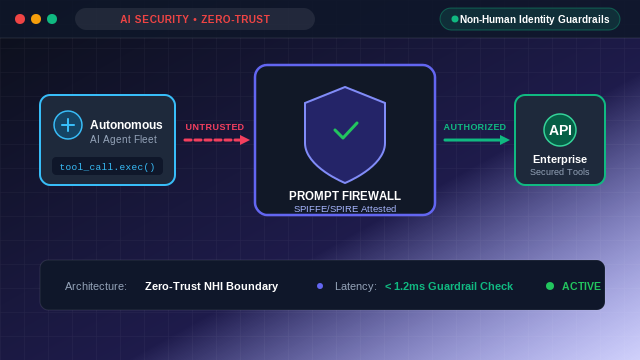
Agentic Security & NHI Guardrails
An owner-described approach to non-human identity, prompt boundaries and policy enforcement for multi-agent tool execution.
Public portfolio project